
Orthophotos
High-resolution, georeferenced orthophotos and orthomosaics for industrial, construction, and real estate needs. Measurement-accurate visual data to support design and decision-making.
Measurement-Accurate Aerial Imagery — Orthophotos and Orthomosaics
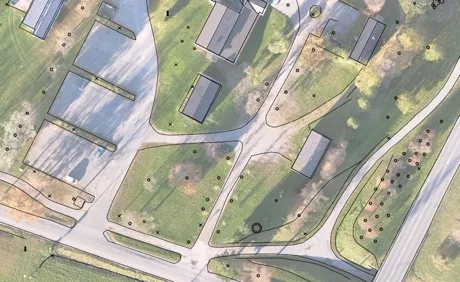
An orthophoto is a rectified aerial image from which distortion caused by the camera angle and terrain elevation differences has been removed. The result is a map-accurate image from which distances, areas, and locations can be measured directly. We produce orthophotos and orthomosaics with RTK GNSS accuracy, making the data suitable as a direct basis for design, documentation, and geospatial analyses.
Benefits of the Service
Measurement-Accurate Data. RTK GNSS accuracy and ground control points ensure centimeter-level positioning. Areas and distances can be measured reliably — the image is measurable, not just illustrative.
Up-to-Date Status Image. Unlike public aerial images often years old, a drone orthophoto is a fresh image of your specific site.
Easy to Share and Use. Delivered in common formats (GeoTIFF) that integrate directly with CAD and GIS tools.
Foundation for Other Services. Orthophotos serve as the basis for elevation models, mass calculation, and more.
Accuracy and GSD — The Right Level for Every Use
GSD (Ground Sampling Distance) indicates how large an area one image pixel covers. We always choose flight altitude and GSD level according to the intended use.
Typical GSD levels:
- under 1 cm/pixel — structural inspections and precise measurements
- 1–3 cm/pixel — construction site monitoring and volume calculation
- 3–5 cm/pixel — regional and land-use planning
- 5–10 cm/pixel — large-area surveys and environmental monitoring
What Orthophotos Are Used For
- Land-use and construction planning
- Construction site documentation and progress tracking
- Real estate and plot analyses
- Measurement of areas and distances
- Basis for geospatial analyses
Who Orthophotos Are For
Construction Companies and Contractors. Track progress and document work phases from above.
Property Developers. Illustrate areas and sites to support planning and marketing.
Municipalities and Cities. Map and document public areas, infrastructure, and environment.
Environmental and Land-Use Stakeholders. Monitor changes with up-to-date, georeferenced data.
GeoAI — Automatic Object Detection
Orthophotos can be combined with GeoAI analysis, where machine learning automatically identifies and classifies objects — buildings, vehicles, vegetation, roads, or water. Results are delivered as vector data in common formats for direct import into your systems.
Part of a Bigger Picture
Orthophotos are often included in construction site mapping and volume calculation, but can also be ordered as a standalone service.
What We Deliver
- Orthomosaic — georeferenced, high-resolution GeoTIFF
- Digital Surface Model (DSM) when needed
- Measurement-accurate area and distance measurements
- GeoAI vector data — automatically detected objects
- Time series — changes documented over time
- Data in the project's coordinate system — ETRS-GKn zone (for example GK22), or ETRS-TM35FIN for wide-area surveys, heights in N2000
Frequently Asked Questions
What's the difference between an orthophoto and a regular aerial image? An orthophoto is geometrically corrected — to scale, measurable. A regular aerial image is not.
How large an area can you capture at once? Tens to hundreds of hectares, merged into a seamless orthomosaic.
In which formats are orthophotos delivered? GeoTIFF and other common geospatial formats compatible with GIS, CAD, and BIM software.
How quickly is the data ready? Typically within 1–2 business days after capture.
In which coordinate system is the orthophoto delivered? In the project's own plane coordinate system. For construction and design projects this is in practice always the municipality's ETRS-GKn zone — typically GK22 in the Jakobstad region. For wide-area surveys, ETRS-TM35FIN is sufficient. Heights are delivered in N2000.
Do weather conditions affect the capture? Yes — best results in calm, dry weather. We plan around the forecast.